The THOMAS Web-Zine
July 2011 Issue 31
Patina
Patina is a tarnish that forms on the surface of metals, a sheen on wooden furniture produced by age, wear, and polishing; or any such acquired change of a surface through age and exposure. On metal, we usually call this 'rust' formed through weathering or neglect. And a patina will occur on other items through simple long-term usage i.e. 'wear and tear'. A broom from the 1960s which is still in daily use has this patina on the handle. Some will say it looks worn-out while others call it "shabby chic"; a recent interior design wave.
Here's a more extreme example.
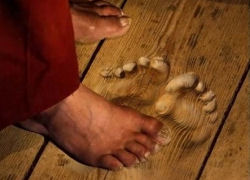 This 70 year-old Buddhist monk Hua Chi has been praying in the same spot at his temple for over 20 years. His footprints etched in the flooring are the result of performing his prayers up to 3000 times a day. (Now that he is 70, he says that he has greatly reduced his quantity of prayers to 1,000 times each day!)
Over time and through continual use a patina will form on everything. So it's not surprising that each of us have our own unique patina. In the physical world our bodies bear the marks of the passing years through the aging process (rusting) and our various activities (wear & tear). As it is on the outside so it is with the inside: our spiritual world has its patina. We might call it experience but much of it has occurred without our knowing (rusted), or has accumulated as various layers of beliefs and understanding as we deal with the world (wear & tear).
How can we know if this has happened? We ask ourselves difficult questions such as:
- Has your love dulled through familiarity?
- Has your charity failed through increasing expectations?
- Has your humility been worn away through pride?
- Has your friendships dwindled through neglect?
- Has your compassion been lost through apathy?
As Jesus grew up he must have acquired his own unique patina; wouldn't it be wonderful to get a glimpse of this? We do get clues that he recognized rusting and wear and tear. There are repeated references to Jesus withdrawing from the group to pray and contemplate. He 'polished his mirror' to remove the rust and he repaired the wear and tear caused by daily attack of his ahamkara to rejoin the Divine Presence. Through 'Thomas' he transformed this work into his key message to the world: overcome your ahamkara and you too will join with the One.
You've read and heard this over and over again; it's a straight forward message yet we often fail to realize its potential. What happens when we 'polish the mirror' and overcome our ahamkara? We see ourselves as we really are; our Real Self, our True Identity, our Original Image. Jesus however gives us this warning:
Jesus said:
In the days you see your resemblance,
you rejoice.
But when you see your images
that in the beginning were in you,
which neither die nor are manifest
oh! how much will you bear! Logia 84
Our reflection in the bathroom mirror may make us content, but the internal reflection of your Real Self may cause great pain: "oh! how much will you bear!"
Are you frightened at what you may discover about yourself or about what you may lose of your personality? This is another fear that we need to overcome as while we remain two we cannot conceive nor experience the One.